
GAS SAFETY ACROSS ESSEX AND EAST LONDON

Certified Gas Safe Engineer based in Southend-on-Sea.
Certified Gas Safe Engineer based in Southend-on-Sea.
Certified Gas Safe Engineer based in Southend-on-Sea.
Gas safety certificate Essex homeowners and landlords can book today. CP12 Gas Heating and Cooling is a team of Gas Safe registered engineers based in Southend, carrying out gas safety inspections and issuing CP12 certificates across Essex and East London.
Same-day certificate issuance. Carbon monoxide checks included. Two-hour appointment slots that suit tenants, occupiers and busy households.
Gas Safe registered — number 638057. 25+ years trading. Same-day CP12s. 24/7 emergency engineer standby.
GAS SAFETY INSPECTIONS
A gas safety inspection is a check of every gas appliance, gas pipe and flue in a property, carried out by a Gas Safe registered engineer. It confirms the installation is safe to use and issues a written record — the CP12 certificate. Annual inspections are a legal requirement for landlords and a strong safety recommendation for homeowners. Faulty gas appliances can leak carbon monoxide, an odourless gas that causes serious illness and death.
Our engineer arrives in the two-hour slot booked, isolates and tests each appliance, records the results on the CP12 and issues the certificate before leaving.
A standard domestic gas safety inspection with one boiler and one gas hob takes 30 to 45 minutes. Larger properties with additional appliances take longer.
NINE CORE CHECKS
Every CP12 we issue is backed by the same nine core checks on every appliance and every gas line. This is what your engineer will do on the day.
Every gas appliance is checked for correct siting, secure fixing and adequate clearance. Misplaced or unstable appliances are flagged for repositioning before certification.
Flue integrity is checked end to end for leaks, damage and correct termination. Any flue fault is reported and, where possible, remediated before the certificate is issued.
An electronic combustion analyser confirms the appliance is burning cleanly and safely. Out-of-tolerance readings point to a service issue and are recorded on the report.
Rooms containing gas appliances need adequate fixed air supply. We check purpose-provided vents are present, unblocked and correctly sized for the appliance load.
Thermostats, timers, gas taps and interlocks are tested for correct operation. Faulty controls affect both safety and efficiency and are noted on the report.
Flame supervision devices and other safety cut-outs are tested at the appliance. A failing safety device is a hard-fail item and cannot be certified until it is repaired.
The appliance is checked against manufacturer gas rate and operating pressure. Incorrect settings waste fuel, shorten appliance life and can cause combustion faults.
A visual check of pipework, joints, isolation valves and casings for damage, leaks, corrosion or unsafe modifications made to the installation since the last inspection.
Gas appliances with an electrical supply are checked for correct polarity, earthing and fused spur where applicable. Unsafe electrical connections are flagged on the report.
YOUR CP12 REPORT
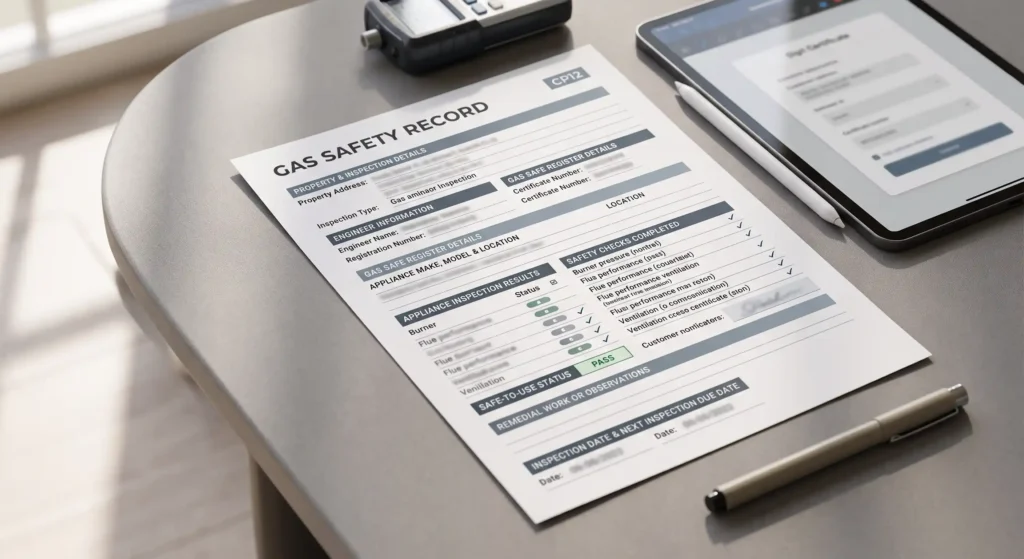
A CP12 is a written record of the inspection and the state of every gas appliance and gas line checked. It is your evidence that a Gas Safe registered engineer has inspected and certified the installation. Landlords must keep the record for at least two years and issue a copy to each tenant within 28 days.
Property address and inspection date, engineer name and Gas Safe registration number, each appliance with make, model and location, checks performed, results and remedial work required, whether the installation is safe to use, and the next inspection due date.
Digital copies are sent to you by email on the day. Printed copies are available on request. For landlord accounts, copies are also issued directly to the tenant where instructed.
CARBON MONOXIDE ALARMS
Carbon monoxide is colourless, odourless and tasteless. It cannot be detected by the human senses. A functioning CO alarm is the only reliable warning. Our engineers supply, fit and test audible CO alarms in every room containing a gas appliance and in any room where residents spend significant time.
In every room with a gas appliance, on every storey of a rented property, and in sleeping areas where practical. Alarms should be sited at head height, away from cooking steam and direct draughts.
Alarms should be tested monthly using the test button and replaced at the end of their stated service life — typically 7 to 10 years depending on model. We check alarm dates on every gas safety inspection.
Symptoms of CO exposure include headaches, dizziness, nausea, breathlessness, collapse and loss of consciousness. If you suspect CO poisoning, get everyone out into fresh air and call 999. Call the National Gas Emergency line on 0800 111 999 for suspected gas escapes.
HEATING SYSTEM ADD-ON
While our engineer is on site, we can carry out a heating system health check alongside your gas safety inspection. Uneven heat, cold radiators and rising bills usually trace back to the wider system rather than the boiler itself. One appointment, two jobs, one call-out charge.

FOR LANDLORDS AND LETTING AGENTS
Private landlords, letting agents and housing associations across Essex and East London use CP12 Gas Heating and Cooling for their annual CP12 obligations. Set up a landlord account, send us your property list, and we book direct with tenants, issue the CP12 on the day and invoice you on 30-day terms..
Certificate issued at the property on the day of inspection, subject to the installation passing without remedial work.
We contact your tenants direct to arrange access — saving your team the coordination time on every renewal cycle.
Volume accounts are invoiced monthly on 30-day terms. Tiered pricing for accounts with 10, 20 or more CP12s per month.
IN AN EMERGENCY
If you can smell gas, or if a carbon monoxide alarm has sounded, act first. Turn off the gas at the meter, open windows and doors to ventilate the property, avoid electrical switches and naked flames, and leave the property. Call the National Gas Emergency line before calling anyone else.
For non-emergency gas faults, boiler breakdowns and other urgent issues, our 24/7 engineer standby line is answered directly.
FREQUENTLY ASKED QUESTIONS
A gas safety certificate — commonly called a CP12 — is a written record of a gas safety inspection carried out by a Gas Safe registered engineer. It confirms that each gas appliance and the wider installation has been checked and is safe to use, and it records any remedial work required. Landlords are legally required to hold a valid CP12 for each let property.
A standard domestic inspection with one boiler and one gas hob takes 30 to 45 minutes. Larger properties, additional appliances or older installations can take longer. Our engineer will confirm the expected duration when booking your two-hour appointment slot.
Landlords must have every let property inspected at least every 12 months. Homeowners are not legally required to have annual inspections but are strongly advised to do so — the check is inexpensive, catches faults early and is a condition of most boiler warranties.
Yes. Wherever the installation passes without remedial work, our engineer issues the CP12 at the property on the day of the inspection. A digital copy is sent to you by email that day. Where a fault is found, we tell you on the day, quote any repair and re-certify once the work is complete.
If an appliance is unsafe, our engineer explains the fault, records it on the report and — with your permission — isolates the appliance to make the installation safe. We quote any repair before we work. Once the fault is fixed and re-tested, the CP12 is issued.